
General Oral & Maxillofacial Surgery
Congenital Craniofacial Deformity Surgery
We provide specialised surgical care for congenital differences of the face, jaws and skull, aiming to improve facial harmony and jaw function and to enhance quality of life, tailored to the needs of each patient.
Key surgical procedures
Facial Skeletal Reconstruction
Correcting underdevelopment and bony deformity of the face and jaws to restore facial balance and improve function.
Cleft Lip and Palate Surgery
Repairing congenital clefts of the lip and palate and improving oral and facial function within a coordinated plan from birth to facial maturity.
Congenital Jaw Deformities and Facial Asymmetry
Repositioning the jaws and correcting congenital skeletal imbalance for better facial harmony and bite function.
Complex Craniofacial Reconstruction
Correcting congenital deformities involving the skull, mid-face and orbits, in collaboration with related medical specialties.
Midface Advancement (Le Fort III)
Correcting mid-face retrusion in some craniofacial syndromes to improve mid-face projection and balance, which may also help breathing or protect the eyes.
Specialised care that begins with careful assessment
Each treatment plan is built on accurate diagnosis, assessment of facial and jaw growth, and individual surgical planning, to achieve the best possible functional and aesthetic outcome.
Overview
We provide specialised surgical care for congenital differences of the face, jaws and skull, aiming to improve facial harmony and jaw function and to enhance quality of life, tailored to the needs of each patient.
Every recommendation follows an individual assessment of your concerns, anatomy and goals. The sections below explain how this treatment is typically diagnosed, planned and carried out.
Who May Benefit
- Children and adults born with a cleft lip, cleft palate or alveolar cleft
- Patients with one side of the face or jaw developing differently from the other since birth
- Patients with a congenital difference in skull, eye socket or midface shape
- Adults treated for a cleft in childhood who still have a jaw or bite discrepancy
Conditions Treated
- Cleft lip and palate, and cleft-related jaw discrepancies
- Alveolar cleft (gap in the gum and bone)
- Congenital facial asymmetry, including hemifacial microsomia
- Craniofacial deformities affecting the skull, eye sockets and midface
- Underdeveloped upper or lower jaw linked to a congenital syndrome
Diagnosis
Assessment starts with a detailed history and facial examination, then 3D imaging (CBCT or CT) to see the bones of the skull, face and jaws. Speech, hearing, breathing, teeth and growth are reviewed together, because congenital conditions often affect more than one function.
Treatment Planning
Treatment is planned with the whole team — often including orthodontics, speech therapy, ENT and paediatrics — and timed around facial growth. Some steps are done in childhood, while jaw correction is usually completed once growth has finished.
Virtual Planning
Virtual surgical planning creates a 3D model of the patient’s own skull and face. Bone movements are rehearsed on the computer first, and custom cutting guides or plates can be produced so the plan is carried out accurately in theatre.
Surgical Overview
Surgery is matched to the condition: alveolar bone grafting to close a gap in the gum and support the teeth, orthognathic surgery or distraction osteogenesis to bring an underdeveloped jaw forward, and reshaping of the skull or facial bones to improve symmetry. Care is often staged over several years.
Recovery
Recovery depends on the procedure. Bone grafting usually needs one to two weeks of a soft diet, while jaw or skull surgery may need several weeks with gradual return to normal activity. Long-term follow-up tracks growth, bite and appearance.
Risks & Considerations
All surgery carries risk. Potential risks are discussed in detail during consultation, and may include:
- Swelling, bruising and discomfort
- Bleeding or infection
- Altered sensation in the lips or face
- Need for further staged procedures as the face grows
- Risks associated with anaesthesia
Frequently Asked Questions
When is congenital craniofacial surgery recommended?
It is recommended when a congenital difference affects breathing, eating, speech, the bite or facial appearance. Timing depends on the condition and on growth: some procedures are done in childhood, while jaw correction is usually done after growth is complete.
Is it done in one operation?
Often not. Congenital conditions are usually treated in planned stages over time, with each step timed to the child’s growth and coordinated with the rest of the care team.
Can adults still be treated?
Yes. Many adults who had cleft repair in childhood still benefit from jaw surgery or bone grafting to improve their bite, breathing and facial balance.
Why Early Intervention?
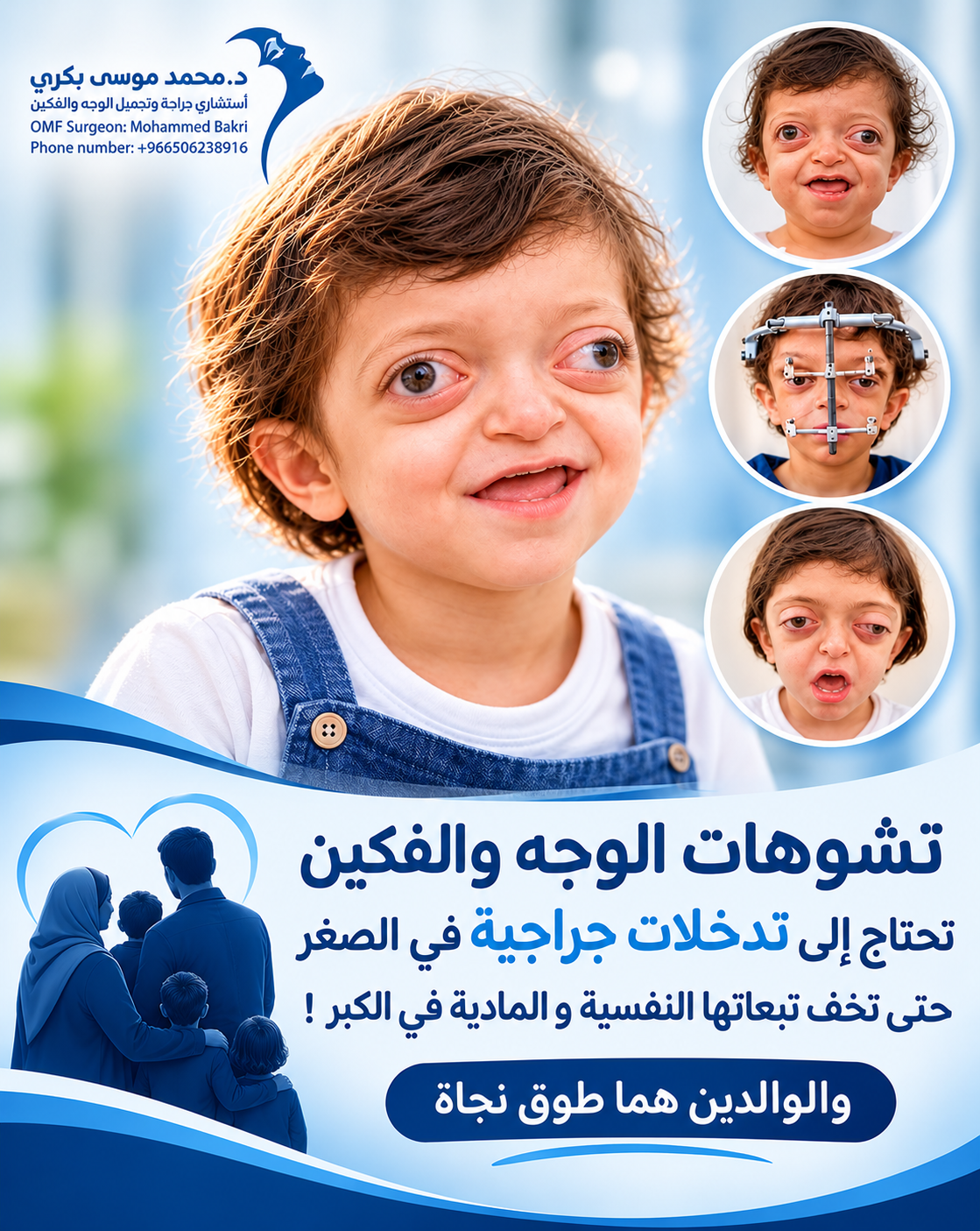
Facial and jaw deformities need surgical intervention in childhood to reduce their psychological and financial burden later in life. Parents are the lifeline.
Discuss your options with Dr. Bakri
A consultation is the first step toward an accurate diagnosis and an individual plan.